
01
Small and mid-sized companies
Digital tasks come up continuously, but an in-house development team would be neither fully utilised nor economical.
Models
Roadmap instead of one-off orders: how companies continuously develop web apps, portals and internal tools – without requesting a new quote for every feature.
Reading time approx. 9 minutes · Last updated 4 September 2026
TL;DR
Software development as a subscription is a monthly model in which companies have technical tasks delivered continuously by an external development team. Instead of calculating every feature, change and technical request separately, there are predictable monthly costs and a continuous delivery process. Requirements are collected, prioritised together and handled one after another. The model is particularly suited to companies that regularly develop websites, web apps, customer portals, automations or digital processes further. It replaces individual commissioning with an ongoing collaboration and fixed points of contact. One important distinction: software development as a subscription is neither a pure maintenance contract nor a prepaid balance, but a structured model for continuous digital delivery. What is usually unlimited is the number of requests, not simultaneous delivery.
Software never gets finished. At best, it gets neglected.
Every company that has built a customer portal, an internal tool or a web app knows this. The first version is barely live when sales comes with a new request, marketing needs another channel, a process changes – and suddenly there's another “small” development topic on the table that nobody has capacity for.
The classic route – request a quote, wait, approve, wait – no longer fits this rhythm. In practice, it creates continuous demand for technical delivery:
Typical ongoing demand
Classic project quotes are often too slow for this kind of demand. Every task passes through briefing, calculation, quote, approval and scheduling. For a relaunch that makes sense; for an additional form flow the overhead is usually out of proportion to the actual work.
An in-house developer only partly solves the problem: the role creates ongoing fixed costs, is hard to recruit for, and a single person rarely covers development, design and quality assurance at once. Freelancers are flexible and often technically strong, but hard to plan around in terms of availability, cover and resilience.
Software development as a subscription – often also called a developer flat – closes exactly this gap: ongoing delivery capacity at fixed monthly costs, with a defined process instead of individual commissioning.
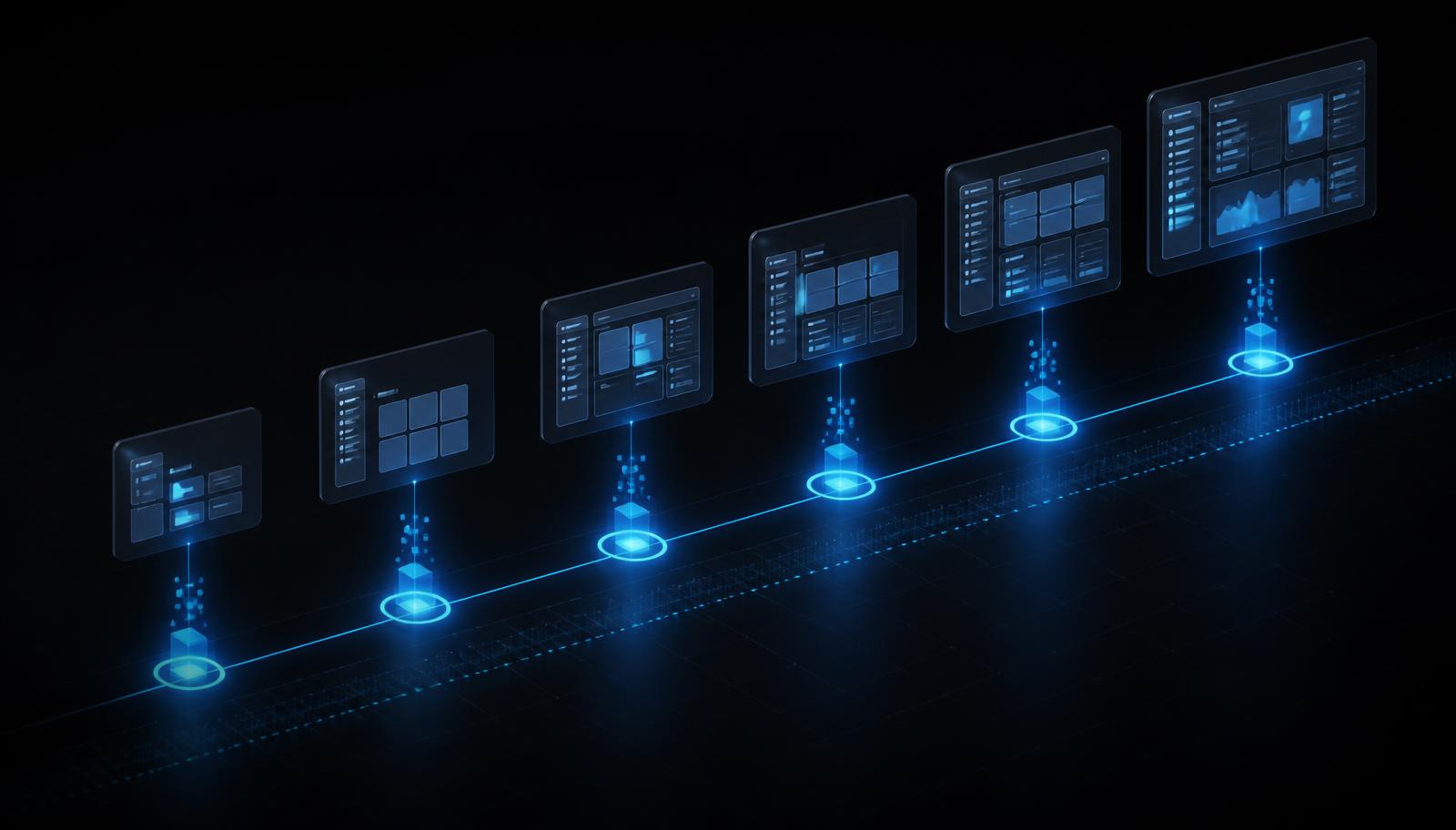
Software development as a subscription means a company pays a fixed monthly amount and in return has permanent access to an external development team. It does not buy a single project but builds an ongoing collaboration. Requirements are submitted continuously, assessed together, prioritised and implemented in sequence – from the first description through development to release.
One realistic expectation matters: even in a subscription, not everything can happen at once. Good providers therefore work with visible prioritisation, clear processes and realistic capacity. There is an order, and larger initiatives are planned deliberately rather than pushed into the running queue.
How it works
Sales, marketing, operations – every request lands in one list.
What creates impact first? What is a separate initiative?
Small, finished steps instead of months-long big-bang releases.
Every change is checked before it goes live.
Feedback flows into the next iteration. The cycle continues.
The model is particularly strong for small and mid-sized tasks that arise regularly and are individually too small for a project quote:
Larger initiatives such as a new platform or an extensive portal can also be delivered on a subscription – but then as planned expansion stages across several months rather than as a spontaneous single task.
The model fits best where technical tasks arise regularly but in varying volume.
01
Digital tasks come up continuously, but an in-house development team would be neither fully utilised nor economical.
02
Product and website change quickly. Delivery speed matters, without building up fixed personnel costs early.
03
Strategy, design and consulting stay in house while technical delivery is outsourced reliably.
04
There is nobody who can implement changes cleanly. An external development team takes on that role permanently.
05
Ideas rarely fail on creativity but on delivery capacity. A subscription makes tests and iterations realistic.
06
Existing systems need care and further development, not a full rebuild every few years.
07
Campaigns, landing pages, tracking changes and forms need short paths instead of long quoting loops.
The model is not a cure-all. In these cases other routes make more sense:
In these situations a classic fixed-price project, a maintenance contract or an hour quota is often the better fit.
The benefits come less from the price than from how the collaboration is organised.
Before
After
A subscription is only as good as the process behind it. Companies should check these points before signing:
01
Without a clear order, tasks compete with each other and important topics are left undone.
02
A new platform cannot be squeezed into the running queue; it needs its own planning and expansion stages.
03
If a quota is effectively being billed, it is not an ongoing delivery model but a prepaid package.
04
If nothing is checked before release, testing effort shifts to the company and into live operations.
05
Unclear requirements cause rework. Short, documented task descriptions solve this reliably.
06
Some packages effectively cover maintenance only, so the scope should be clarified in writing before signing.
The overview below describes the typical shape of the common models. Individual providers may differ.
| Model | Benefits | Drawbacks | Suited for |
|---|---|---|---|
| Software development as a subscription | Predictable monthly costs, fast start, ongoing prioritisation, several skills in one team | Not everything at once, capacity must be used, provider choice determines quality | Companies with regular, changing delivery demand |
| Classic software agency | Binding scope, strong concept work, clear acceptance, good documentation | Quoting loops per task, slower on small items, add-ons when scope is unclear | One-off large projects with a clear goal and fixed budget |
| Freelancer | Often very strong technically, direct communication, flexible commissioning | Limited availability, absence risk, rarely a second-pair-of-eyes review | Clearly scoped specialist tasks and additional capacity |
| In-house developer | Maximum context, daily availability, system knowledge stays in house | Fixed costs, hard to recruit, one person rarely covers all disciplines | Permanent full utilisation and heavily custom-built systems |
| Maintenance contract | Secure operations, updates, backups, availability in case of incidents | No further development, new features must be commissioned separately | Stable systems without planned functional changes |
| Prepaid hour package | Transparent billing, good cost control, no ongoing commitment | Quota runs out, reorders slow things down, no continuous planning | Sporadic, well-plannable demand without ongoing development |
There is no credible single figure. Costs depend on the scope of services, the committed response time, the complexity of the tasks and the support included. A model covering only website care is priced well below one that includes development, design, quality review and technical advice.
The system landscape also affects the price: a standard CMS is assessed differently from a custom web app with interfaces, role logic and data protection requirements.
Compared with a permanent hire, a subscription can be more economical as long as one person would not be permanently fully utilised. Once that utilisation is reached, the calculation often reverses. The monthly price alone is therefore not enough for a sound assessment.
Cost logic
1
Roadmap
One prioritised list instead of scattered requests in emails and meetings.
1×
Monthly amount
Predictably budgetable – no one-off sum and no change orders per feature.
∞
Requests
Submit without limit, deliver by priority – one after another, not all at once.
Also compare these points:
These criteria can already be checked in the first conversation:
LootSquad understands software development as a subscription as ongoing digital delivery for companies. The focus is on websites, web apps, technical development, clear points of contact, quality review and predictable monthly collaboration. Tasks are documented, prioritised and reviewed before release; larger initiatives are planned deliberately instead of being pushed into the running queue. The goal is not to sell individual hours, but to keep companies capable of acting over the long term – and where a classic project is the better route, we say so.
Software development as a subscription pays off for companies that have regular digital tasks and want to make technical delivery more predictable. Anyone looking to deliver a single, clearly scoped initiative is better served by a project model. What matters is that the subscription does not just sound affordable, but works cleanly in day-to-day operations: with prioritisation, reliable communication, quality review and genuine ownership of the result.
A company pays a fixed monthly amount and has technical tasks delivered continuously by an external development team. Tasks are collected, prioritised and handled in sequence instead of being calculated individually.
Mainly for companies with regular but varying delivery demand: ongoing website and web app changes, landing pages, automations or portals – without building a full-time in-house development team.
The terms are mostly used synonymously. Both describe ongoing development work at fixed monthly costs. What matters is not the label but whether delivery really runs continuously or an hour quota is simply being billed.
A maintenance contract secures operations: updates, backups, security and bug fixing. Software development as a subscription additionally covers further development, meaning new features, new pages and ongoing adjustments.
Yes. Larger initiatives are split into planned expansion stages and delivered across several months so they do not block day-to-day operations and the remaining prioritisation.
With LootSquad companies get an external delivery team for websites, web apps and ongoing digital projects. With clear processes, fixed points of contact and predictable monthly costs.
Learn more about the subscription modelWe use cookies to give you the best possible experience on our website. Some cookies are required to operate the site, others help us improve it and show personalised content. Learn more