
01
Unclear contract terms
Minimum terms, notice periods and automatic renewals are often buried deep in the contract.
Decision
Pay once or monthly? Why the real question isn't the payment model but what happens after launch – and how to answer it honestly for your company.
Reading time approx. 9 minutes · Last updated 4 Sept 2026
TL;DR
Buying a website usually means commissioning a one-off project with a fixed scope: design, build, acceptance, invoice. A website subscription spreads creation, support and ongoing development across monthly costs and continues after launch. Buying makes sense when scope, design and features are clearly defined and few changes follow. A subscription model is the better fit when the website needs to be adjusted, extended or looked after regularly. So what matters is not just the price, but whether the company needs ongoing digital support after launch. Answer that question honestly and the decision is usually made.
Pay once or pay monthly? This question comes up in almost every website project – and it's usually asked the wrong way.
At first glance, buying looks clearer: one quote, one invoice, done. The subscription looks more predictable: small amount, no big lump. Both impressions are true – and both fall short. Because the real question isn't “how do I pay?” but “what happens after launch?”
If nothing changes for two years after go-live, buying is the better deal. If you need new offers, campaigns, forms, prices or features every few weeks, buying ends up costing twice: once for the project and then for every single change, each with a quote, waiting time and coordination.
This article sorts both models objectively: what they mean, where they fit, what they cost – and which traps companies fall into on either side.
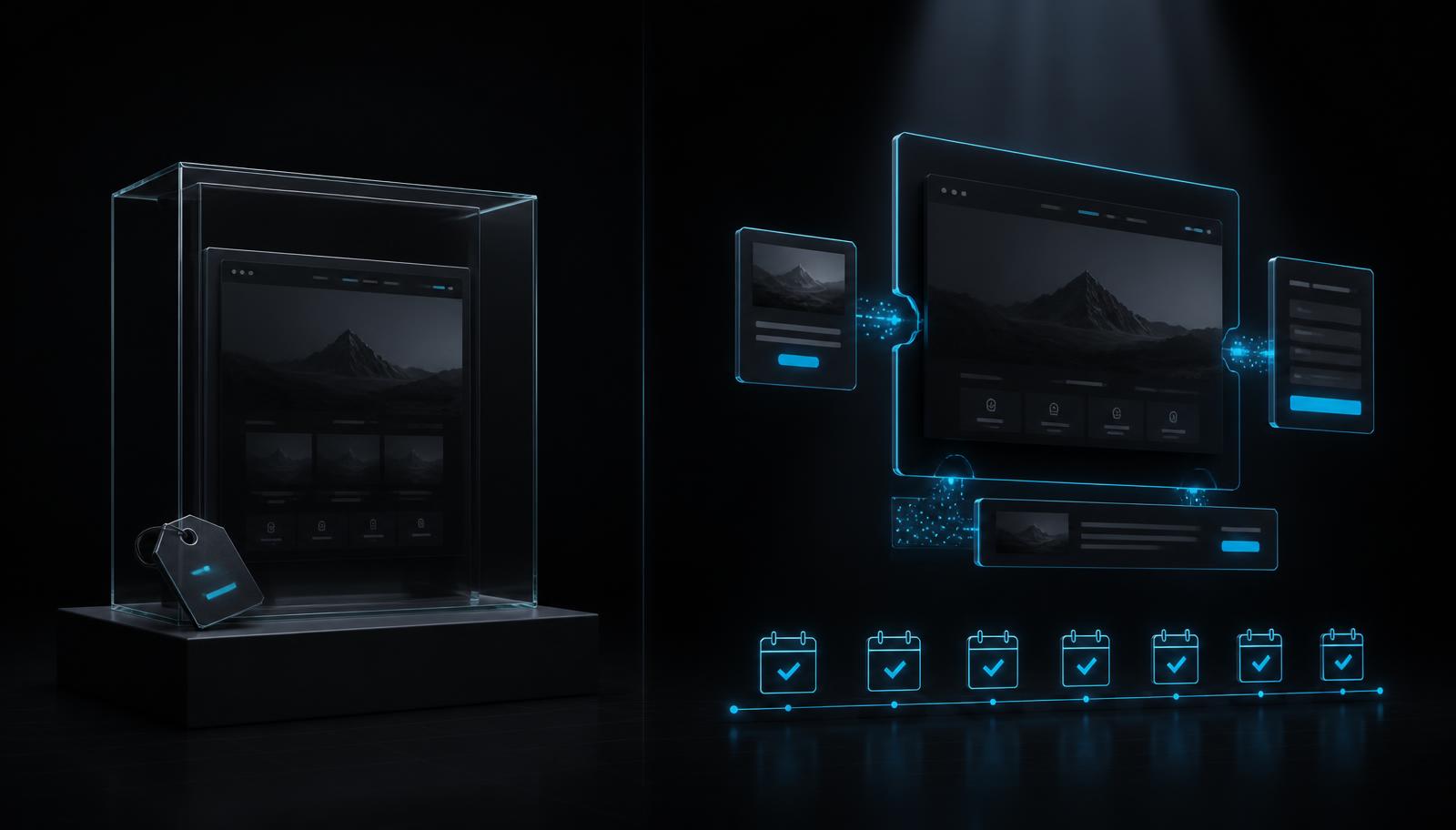
Buying a website usually means a provider builds it as a one-off project. The scope is defined beforehand, then accepted and paid for. After launch the project is formally closed – whatever comes next is a new order.
Buying a website is not worse. It fits well when the company knows exactly what it needs and expects little ongoing work after launch – or can handle it in-house.
With a website subscription, the company pays monthly. Depending on the provider, the fee covers only hosting and maintenance – or also creation, ongoing adjustments and development. The collaboration doesn't end at launch; that's where it really begins.
Important: not every website subscription is automatically a genuine website flatrate. Some models include only hosting and maintenance, others also ongoing delivery. This distinction decides whether the subscription is an operations model or a development model.
The following table sets both models side by side along the criteria that make the difference in practice.
A
B
| Criterion | Buying a website | Website subscription |
|---|---|---|
| Cost structure | One-off project price, then individual invoices for changes | Fixed monthly amount, changes included within scope |
| Initial investment | High, due before or at launch | Low to moderate, spread across the term |
| Ongoing changes | Request, cost, commission separately | Submit, prioritise, build – no new quote |
| Flexibility | High during creation, sluggish afterwards | Continuously adjustable, but prioritisation needed |
| Support | Ends with acceptance, maintenance optional | Permanent contact, support at the core |
| Technical responsibility | Transfers to the company after acceptance | Stays with the provider while the subscription runs |
| Ownership and access | Website and content belong to the company | Regulate contractually: content, domain, access, exit |
| Predictability | Project costs clear, follow-up costs unclear | Monthly clear, watch total term |
| Risk | Goes stale without care, changes pile up | Dependence on provider, contract terms |
| Suitable for | Bounded relaunch with little follow-up demand | Actively used website with regular change demand |
Buying is right when the project really is a project – with an end. Typical situations:
The subscription pays off when the website should keep working after launch – and nobody in-house has the time or the technical skills:
Many companies compare just two things: who owns the website, and what does it cost? Both are legitimate – and both miss the point.
What matters is whether the website lives on after launch. A purchased website that is not maintained, extended or optimised afterwards quickly loses impact: content goes stale, offers no longer match, forms break, tracking runs into nothing. Ownership is then complete – the benefit is not.
Conversely, a subscription is only valuable if it actually delivers agility: changes get made, bugs get fixed, new pages get built. A subscription that includes only hosting and a login is not a development model – it's rent.
So the right question is: who makes sure the website still does what the company needs in six, twelve and twenty-four months?
The honest answer: it depends on the timeframe and the demand for change. Buying can be cheaper if only a one-off project is really needed and hardly anything happens afterwards.
A subscription can be more economical when ongoing changes, support, technical adjustments and development arise regularly – because with a purchase, each of these tasks is requested, costed and paid for individually, often with waiting time and internal coordination effort on top.
That's why companies should not compare just the monthly price or the project price, but the total effort over 12, 24 or 36 months – including the costs that never appear on an invoice.
Cost logic
12–36
Months to compare
Only calculated over the term do purchase and subscription become comparable at all.
9
Cost items
From creation to dependence – all belong in the calculation, not just the starting price.
1
Decisive question
Who makes sure the website still does what you need in a year?
These items belong in a fair comparison:
How it works
How many changes realistically arise per quarter?
Who maintains, reviews and coordinates in-house – really?
Calculate 12, 24 or 36 months, not just the starting price.
Clarify term, access, exit, service limits.
Project with an end → buy. Ongoing channel → subscribe.
Not every subscription delivers what the monthly price promises. Check these points before signing:
01
Minimum terms, notice periods and automatic renewals are often buried deep in the contract.
02
“Changes included” sometimes means: two text corrections per month. Everything else costs extra.
03
Setup fees, surcharges for forms, languages or integrations only appear after the start.
04
Content, domain and system access sit with the provider – making a switch expensive or impossible.
05
The subscription keeps the website online but doesn't develop it. New pages or features aren't part of it.
06
Builder design with a swapped logo – functional, but interchangeable.
07
Changes go live unchecked. Errors only surface when customers report them.
Buying has its blind spots too – they usually show months after launch:
LootSquad does not see a website as a one-off project but as part of ongoing digital delivery. After launch, companies almost always need changes, new pages, technical adjustments, quality assurance and clear contacts. That's why LootSquad focuses on predictable collaboration, ongoing delivery and clean processes – with the website as part of a system, not a finished object.
Buying a website is worth it when a clearly bounded project with little ongoing demand arises. A website subscription is the better fit when the website needs regular support, adjustment and development. What matters is not just who owns the website, but whether it is permanently maintained, improved and kept technically clean – and who actually does that day to day.
Not as a rule. A subscription fits better if the website needs ongoing adjustment and support. Buying fits better for a clearly bounded project with little follow-up demand. What matters is the demand after launch, not the payment model.
The contract decides. Reputable providers guarantee that content, domain and access belong to the company or are handed over at the end of the contract. Clarify before signing what can be taken along on exit.
When changes arise regularly, there is no technical person in-house and predictable monthly costs matter more than a one-off payment. Especially when the website is actively used for marketing and sales.
Typically hosting, maintenance and security updates, plus every later change as an individual order. Add internal time costs for coordination. These items are missing from the project price but accrue over the term.
A website subscription may include only hosting and maintenance. A website flatrate has ongoing delivery at its core: changes, new pages, landing pages, forms. Every flatrate is a subscription, but not every subscription is a flatrate.
With LootSquad, companies get ongoing support for websites, web apps and digital delivery. With clear processes, dedicated contacts and predictable monthly costs.
View website flatrateWe use cookies to give you the best possible experience on our website. Some cookies are required to operate the site, others help us improve it and show personalised content. Learn more