
IT flat rate
IT Flat Rate for Companies: What's Included?
IT flat rate sounds like one thing - but it's at least five different models wrapped in a single word. Anyone who doesn't know the difference between operations and development ends up booking the wrong service.
Reading time approx. 8 minutes · Last updated 09/04/2026
TL;DR
In short: What is an IT flat rate for companies?
An IT flat rate is a monthly model in which companies receive certain IT services at predictable cost. Depending on the provider, this can cover classic IT support, maintenance, helpdesk, security, website care, or digital delivery. A precise distinction matters: an IT flat rate for computers, networks and support is not the same as a developer flat rate or software development as a subscription. Companies should therefore check whether they need technical operations, support, or active digital development. The term “IT flat rate” is broad and needs to be explained concretely.
Many companies look for predictable technical support. They don't want to request a new quote for every small task or have no contact person when problems arise. A fixed monthly fee instead of fluctuating individual invoices sounds like exactly the solution they need.
At the same time, “IT flat rate” is a broad term that can mean very different services. One provider means helpdesk and workstation support, the next means a combination of maintenance and a few support hours, and yet another means ongoing digital development of a website and software.
This vagueness regularly leads to disappointment: a company books an “IT flat rate” expecting website changes and new features - and instead gets ticket support for printers and email inboxes. Both are legitimate IT work. But they are two completely different needs.
This article sorts out the term. It shows what classic IT flat rates typically include, what digital delivery means instead, and how both worlds relate to developer flat rates, website flat rates and software development as a subscription - so you know before signing what you're actually getting.
What classic IT flat rates often include
The classic IT support core revolves around operation, stability and security of internal infrastructure. This typically includes:
- Helpdesk
- First point of contact for technical problems in daily work, usually reachable via ticket, phone or chat.
- Workstation support
- Setup, maintenance and troubleshooting for employees' computers, laptops and peripheral devices.
- Email systems
- Management of mailboxes, spam filters, access rights and email security.
- Device management
- Overview of hardware, licenses and software versions across the entire company.
- Network
- Operation and protection of Wi-Fi, VPN and internal network infrastructure.
- Servers
- Operation, maintenance and availability of local or virtual servers.
- Backups
- Regular data backup and recovery processes in case of an emergency.
- Security
- Antivirus protection, firewalls and basic defense against common threats.
- Updates
- Applying system and software updates so security gaps stay closed.
- Monitoring
- Ongoing monitoring of systems to detect outages early.
- Support
- General technical assistance for questions and issues in day-to-day operations.
What digital delivery means
Digital delivery means not just IT operations, but active development. This typically includes:
- 01Website changes
- 02Landing pages
- 03Web development
- 04Web app features
- 05Automations
- 06Interfaces
- 07Internal tools
- 08Customer portals
- 09Conversion optimization
These tasks rarely appear in classic IT flat rate descriptions - not because they're unimportant, but because they're a different kind of work. It's not about keeping an existing system running, but about building something new or noticeably advancing existing digital channels.
IT flat rate vs. developer flat rate
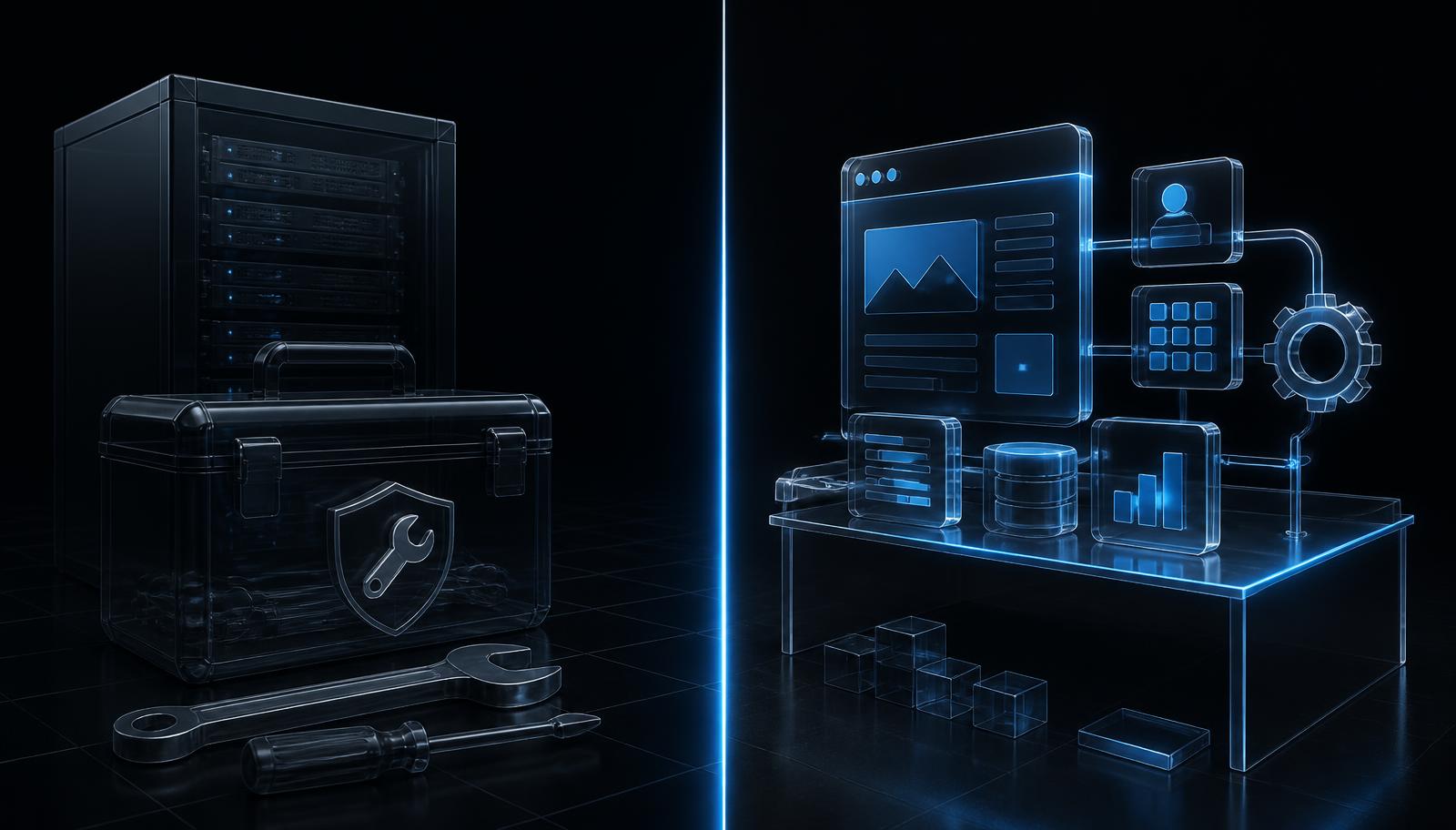
An IT flat rate often takes care of operations and support: computers run, networks stand, emails arrive. A developer flat rate, on the other hand, focuses more on ongoing technical delivery - website changes, web development and digital advancement that goes beyond pure operations. Both models can complement each other well because they solve different problems: one keeps the technology alive, the other moves it forward.
IT flat rate vs. website flat rate
A website flat rate focuses on ongoing tasks around a website: text, pages, forms, smaller features, technical upkeep of the web presence. An IT flat rate can be considerably broader and cover many areas of a company - but it doesn't automatically include website changes or web development. If you expect a maintained, growing website, clarify this explicitly rather than deriving it from the term “IT flat rate.”
IT flat rate vs. software development as a subscription
Software development as a subscription means ongoing development of features, web apps, tools or digital processes - i.e. active programming work over a longer period. Classic IT flat rates often don't include such development services, or only to a limited extent, because they require a different skillset and a different rhythm of work than classic IT support.
Comparison table: which model does what?
The following overview classifies the five common models by focus, typical scope and suitability.
A
Classic IT flat rate
- Focus on operations, support, security
- Helpdesk, maintenance, backups, monitoring
- Keeps existing systems stable
- Rarely includes website or software development
- Fits companies without their own IT department
B
Developer flat rate / software subscription
- Focus on ongoing digital delivery
- Website changes, web apps, automations
- Actively advances digital channels
- With prioritization and quality assurance
- Fits companies with ongoing delivery needs
| Model | Typical focus | Often includes | Doesn't automatically include | Suitable for |
|---|---|---|---|---|
| Classic IT flat rate | Operation, support, security of internal systems | Helpdesk, maintenance, backups, monitoring | Website changes, software development | Companies with stable IT operations that need care |
| Developer flat rate | Ongoing technical delivery and development | Website changes, small development tasks, prioritization | Classic workstation support, hardware maintenance | Companies with ongoing digital delivery needs |
| Website flat rate | Ongoing tasks around a website | Text changes, new pages, forms, smaller adjustments | Web apps, internal tools, classic IT support | Companies with an actively used, growing website |
| Software subscription | Ongoing development of features and tools | Web app features, interfaces, automations | Classic IT support, workstation care | Companies with their own product or internal tools |
| Maintenance contract | Preserving the existing state | Updates, security patches, bug fixes | New features, active development | Companies that just want to keep an existing system stable |
5
Models compared
IT flat rate, developer flat rate, website flat rate, software subscription and maintenance contract solve different problems.
9
Questions before signing
From scope to hour limits - these points should be clarified before any signature.
1
Decisive distinction
Is it about operating existing systems or actively developing them further?
Who is an IT flat rate worth it for?
An IT flat rate is worth it for companies that need regular support, stable systems, fast help and predictable IT costs. If daily operations depend on working workstations, secure systems and a reachable contact person, that's exactly the job classic IT flat rates are made for.
- 01Regular technical support in daily business is needed
- 02Stable operation of workstations, network and servers is a priority
- 03Predictable monthly IT costs matter more than individual billing
- 04There is no in-house IT department
- 05Security, backups and updates should run reliably
For whom is an IT flat rate not enough?
A classic IT flat rate is often not enough if:
- 01website changes arise on an ongoing basis
- 02marketing needs technical implementation
- 03web apps are supposed to be developed
- 04digital processes are supposed to be automated
- 05new landing pages or portals are supposed to be created
- 06active product or website growth is planned
Questions companies should ask before signing
Before signing a contract, it's worth taking a close look at the actual scope of services:
- 01What exactly is included?
- 02Are website changes included?
- 03Is real development included?
- 04Is there prioritization?
- 05Are there response times?
- 06Is there quality assurance?
- 07Are tasks documented?
- 08Are there hidden hour limits?
- 09What happens with complex tasks?
- 1
Clarify the need
Is it about stable operations or ongoing digital development?
- 2
Check the scope of services
What's actually in the contract - not just in the sales pitch?
- 3
Compare models
Contrast IT flat rate, developer flat rate, website flat rate and software subscription.
- 4
Ask questions
Clarify prioritization, response times, quality assurance and hour limits.
- 5
Choose the right model
Secure operations, buy digital delivery separately if needed.
How LootSquad separates digital delivery from classic IT support
LootSquad doesn't focus on classic workstation IT support, but on ongoing digital delivery for companies. This includes websites, web apps, technical adjustments and development - with clear contacts, prioritization and quality assurance as a fixed part of the collaboration.
Conclusion
An IT flat rate can help companies make technical support more predictable. What matters, though, is whether it's about classic IT support or active digital delivery. Companies with ongoing website, web development or software tasks should check carefully whether a developer flat rate or software development as a subscription fits their needs better.
Frequently asked questions about IT flat rates for companies
What's included in an IT flat rate?
Typically helpdesk, workstation support, network, servers, backups, security, updates and monitoring. The exact scope varies greatly between providers and should be clearly defined in the contract.
Is an IT flat rate the same as a developer flat rate?
No. An IT flat rate usually covers operations and support, while a developer flat rate focuses on ongoing technical delivery and development such as website changes or web development.
Are website changes included in an IT flat rate?
Not automatically. Classic IT flat rates focus on internal systems, support and security. Website changes are more likely to belong to a website flat rate or developer flat rate.
Who is an IT flat rate worth it for?
For companies that need regular support, stable systems and predictable IT costs, but don't expect ongoing digital development such as new features or web apps.
What's the difference between IT support and software development as a subscription?
IT support keeps existing systems running. Software development as a subscription continuously develops new features, tools or digital processes - that's active delivery work, not pure operations.
Further reading
Need more than classic IT support?
LootSquad supports companies with ongoing digital delivery for websites, web apps and technical development. With clear processes, fixed contacts and predictable monthly costs.
View developer flat rate